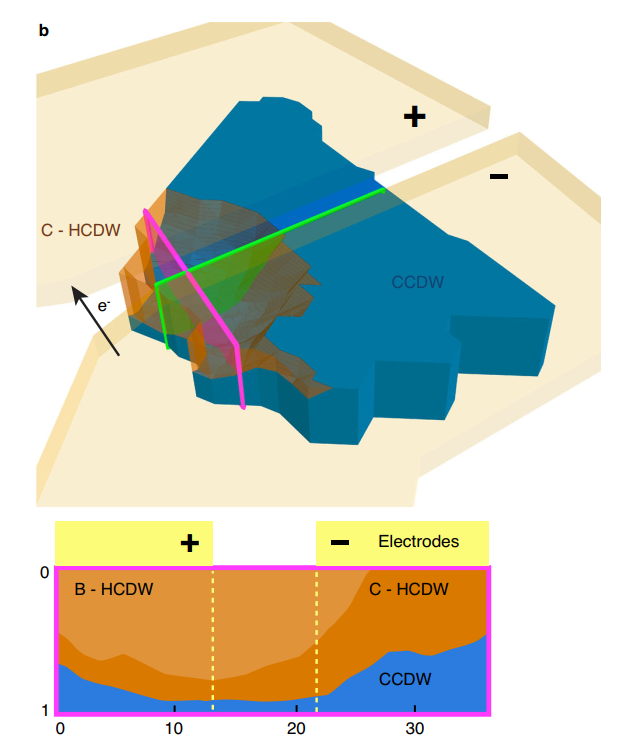
Our latest scientific contribution presents the use of advanced X-ray imaging techniques to watch, in real time, how an exotic “hidden” metallic state forms inside the quantum material 1T-TaS₂ when it is electrically switched. Unlike conventional memristors that create tiny conductive filaments, this material develops a broad, long-range conductive region that spreads deep beneath the electrodes. The discovery clarifies how the material reorganizes its charges and lattice structure during switching—an insight that could enable ultralow-power cryogenic memory for future quantum computers. The work also highlights the growing power of non-destructive 3D X-ray microscopy for probing electronic phase changes in next-generation materials.
Research was conducted in collaboration between the Paul Scherrer Institute, Jozef Stefan Institute, Faculty of Electrical Engineering (University of Ljubljana) and Nanocenter.
Read full article: https://www.nature.com/articles/s41467-025-65212-1