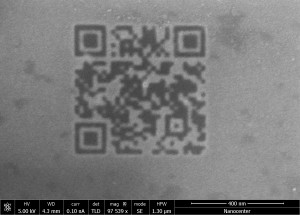
At the Nanocenter, we produced a functional QR code that is more than six times smaller than the QR code that currently holds the Guinness World Record for the smallest QR code.
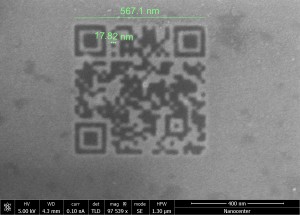
At the Nanocenter, we have produced a nanometer-scale functional QR code using the Focused Ion Beam (FIB) technique. The code was created by ion beam milling on the surface of a silicon substrate. Its total area is 0.321 µm² (567 × 567 nm), while the individual QR code pixels measure only 17 nm.
For comparison, researchers at TU Wien produced a QR code with an area of 1.98 µm², which has been recognized as the Guinness World Record for the smallest QR code (more information: https://www.tuwien.at/en/tu-wien/news/news-articles/news/weltrekord-der-kleinste-qr-code-der-welt). The QR code produced at the Nanocenter is more than six times smaller.
Our QR code is so small that approximately 140 such codes would need to be placed side by side to match the thickness of a single human hair. To make the code visible, a magnification of about 100,000× is required, which can be achieved using a scanning electron microscope (SEM).
The fabrication of such a small QR code primarily serves as a demonstration of the capabilities of the technology and illustrates how large amounts of information can be stored in a very small area. In the field of ion beam milling using the FIB technique, there is still significant potential for further improvements. In the future, such approaches could enable very high data storage densities, comparable to or even exceeding those of modern SSD drives.
The news was also published in the Znanoteh section of the newspaper Delo.